The Stories Behind the Hazelnut Inn
A field guide to missing captains, rabbits with excellent taste in real estate, and dragons who don’t take their family history too seriously.
Each of our three suites belongs to someone who doesn’t exist. The evidence, however, is real: a ship in a tower, a charred hearth, a dragon carved into a door.
We invented these characters to help us imagine the place, and their stories helped us decide what belonged in it. Then a few villagers turned up who don’t always agree with us, or with each other. Here’s how the stories began.
The North Star: The Captain Who Never Came Home
The North Star Suite started with a captain. Maybe an explorer or a pirate: Captain Temperance Longbottom. My sister Becke, who runs the inn, suggested she return the gold instead of stealing it; a sort of reverse Indiana Jones. So Temperance became a philanthropist privateer (and a cryptobotanist).
She relieved pirates of a hoard stolen from mythical civilizations. We imagined she could sense these relic’s magic but never use it, the curse of a squib. Hence “Longbottom,” in honour of a certain wizard. Returning these treasures to their rightful homes became her life’s work, until she disappeared chasing the lost city of Atlantis.
Her ship, the Avellana, came home without her. Its name comes from Corylus avellana, the hazelnut, a little joke for guests who read the fine print.
We needed to put the ship somewhere, so we stuffed it into her house. We wanted something that would stop traffic at the front of the property, and a ship embedded in a tower seemed likely to do the trick.
According to our legend, an extraordinary wind carried the vessel over the mountains and drove it into the stonework. The truth involved a little more heavy machinery. We built the ship in sections in our workshop, then eased the hull through its rounded doorway with two forklifts and half an inch of clearance on either side. We trucked it next door, craned it onto a concrete plinth, and built the walls around it.
In the garden, a twelve-foot elephant head sits among weathered sculptures. Further along sleeps a second enormous stone head (my personal favourite). Both look like cargo our captain couldn’t squeeze through her front door.
Where she went, and why her ship returned without her, remain open questions. Perhaps she’ll come back one day. But given where she parked, she’ll have some explaining to do.

The Under Hill: A Very Comfortable Hole in the Ground
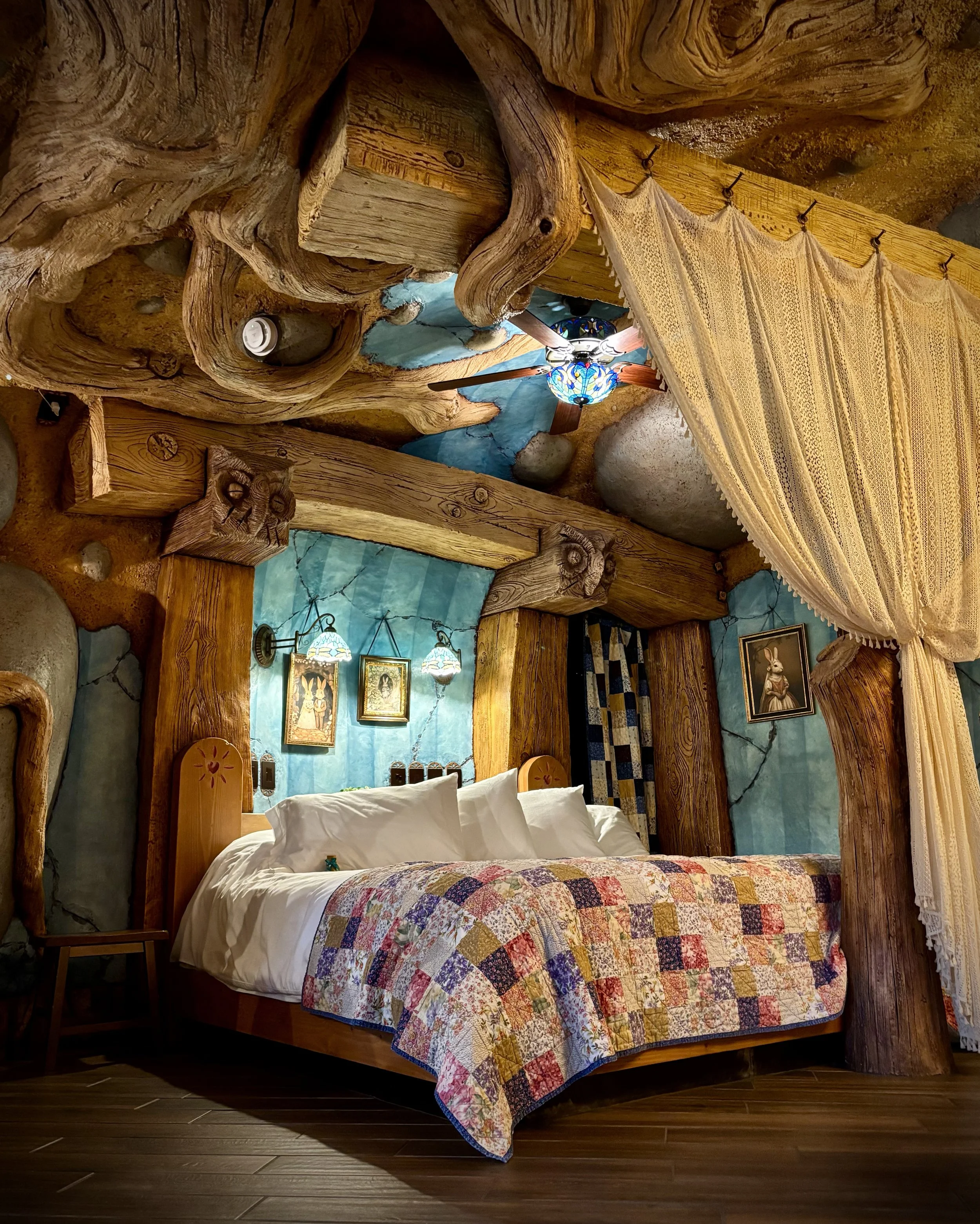
The Burrows family has lived beneath the hill longer than anyone can remember, definitely since before the Hazelnut Inn existed.
There are rumours of a rabbit heritage, but we wouldn’t want to make unsupported claims about the family tree. They do live underground, and they consider stairs beneath their dignity. But the motto over the door, carved in phonetic script, suggests another story:
eɪ hoʊl ɪn ðə ɡraʊnd miːnz ˈkʌmfət
Sound it out, and yes, we were thinking of hobbits.
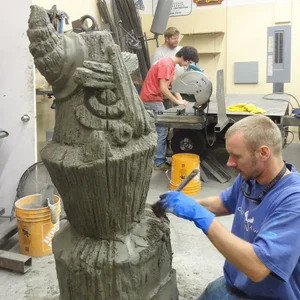
Making a new building look as though a family has lived in it for generations takes more work than you’d expect. The tree roots across the ceiling are sculpted concrete over welded steel armatures, all carved by hand, as are the boulders cradling the enormous bath. The bath was designed for a particular fictional gentleman who likes to submerge himself up to the nose.
We scorched the hearth mantel to suggest generations of fires. Dried flowers hang over the kitchenette at a height tall guests discover with their foreheads, which tells you something about the stature of the family patriarch, old Mr. Burrows.
Baba Zayka, his thrice-great-grandmother, was the family witch (because every family needs one). As our story goes, heavy night mists once rolled off the Vedder River and kept the village awake, so she cut a branch, rubbed it with hazelnut oil, bundled dried yarrow at the base, and swept the valley clear. No mighty sword or dramatic battle, just a woman with a broom and a practical approach to an inconvenient supernatural problem.
It’s a local legend in the literal sense: the river, the hazelnuts, and the yarrow are all just outside the gate. Mr. Burrows claims the broom still guards his door on full-moon nights. We haven’t decided whether he believes it himself.
Of course, he couldn’t stay forever. Where would our guests sleep? One morning over breakfast, he put on his best waistcoat and went to see a bit of the world. He thought it a shame to leave such a comfortable hole empty, so he entrusted it to us.
The Copper Crown: Two Histories, One Dragon
The Copper Crown began with a pun.
We gave the suite a name that could be read two ways: a crown made of copper, or a family called Copper wearing a crown. The motto, Coronati apud aercus, “crowned with copper,” supports both readings.
Two readings soon became two histories.
According to the Crown loyalists, a champion of the ancient family discovered Aerca, a great dragon matriarch whose scales shone like burnished copper and a dynasty of dragon riders was born.
The Copper clan tells it differently. Its ancestors were hazelnut farmers here in Yarrow, and its heroine was Aveline Copper, a girl who found Aerca injured and unable to fly. She shared her bread and water with the dragon. No conquest, no inherited title, only a willingness to help a creature in need.
We began to wonder whether the Coppers ever rode dragons at all, or whether they simply farmed tarragon, whose Latin name means “little dragon.”
Meanwhile, the two factions keep arguing over who built the castle. We’ve given them plenty of evidence: dragon carvings, armoured figures in the great hall, and a steel dragon guarding the garden gate.
The best exhibit is the chandelier. Eight feet across, with four dragon heads, it took four of us to hang. If a dragon family didn’t build the castle, somebody (us) went to a great deal of trouble.
The floors stay warm year-round, so you can decide whether that’s a sleeping dragon under there or just the in-floor heating. If you’re lucky, you might even wake her and go for a ride.

Philbert: The Witness Who Won’t Talk
Philbert began with an email address.
We needed an email account for the inn, and some utility companies won’t accept a generic address like office@. We didn’t want to use anyone’s name, since several of us would be using it, so we invented Philbert. Yet another hazelnut pun.
The address became a person, who became our groundskeeper and warden of passwords. The Netflix account falls under his jurisdiction, too. He’s a bit cantankerous and likes to mutter about “infernal technology.”
We also invented a little local gossip to go with him. Apparently, Philbert is an ancient fairy woven into the foundations of the inn. He knows the valley’s oldest stories, which means he knows which of the Copper Crown’s histories is true.
But ask him, and he changes the subject.
Still Making It Up
The stories and the building fed each other: the histories told us what to build, and what we built gave the histories new twists. A pun became a family feud, a broom acquired supernatural powers, and an email address became an ancient fairy.
We’re still discovering this world. We haven’t settled every question, and we don’t want to. The villagers can keep arguing about who built the Copper Crown. Captain Longbottom can keep chasing Atlantis, and Mr. Burrows can take as long as he likes to come home.
And if you happen to meet Philbert and he tells you the real story, please don’t tell us. Sometimes a little mystery is nice.
FURTHER READING
You can learn more about our design process here: From Story To Suite: Designing The Hazelnut Inn
You can learn more about our construction process here: Building From A Story
You can find our entire story archive here: Legends & Lore